Restaurant Simulator Choice
Takeout Focused Guide
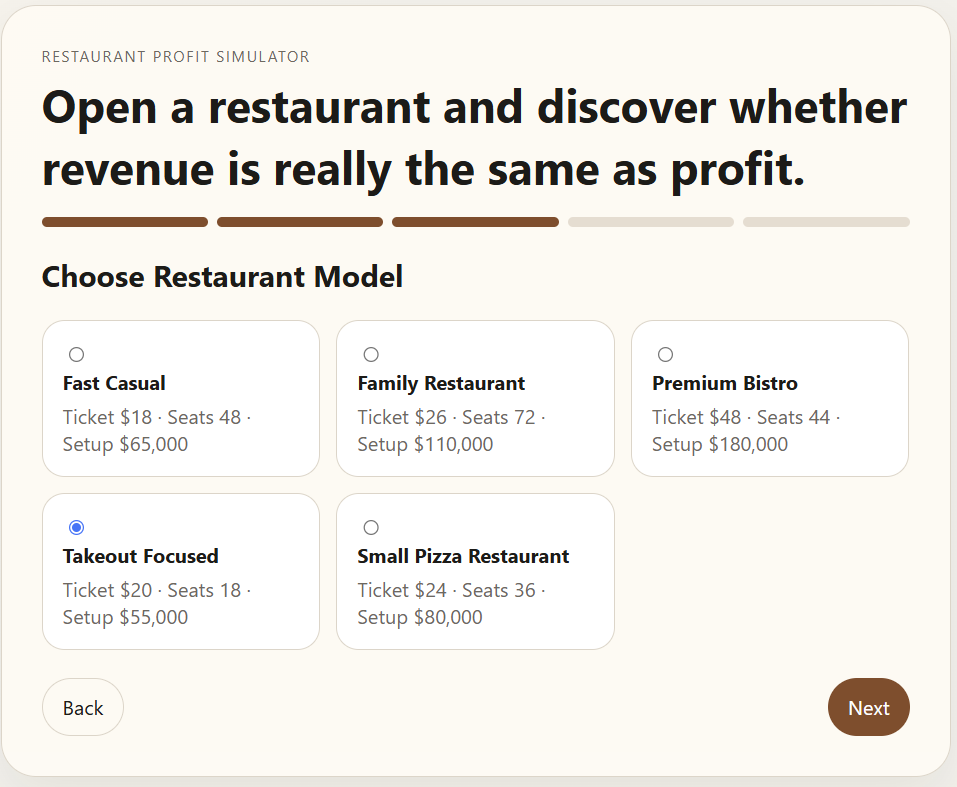
Why Takeout Focused plays differently
Takeout Focused is built around small seating, lower setup cost, and a large delivery share. It can grow quickly because it does not rely on filling a large dining room, but delivery platform fees can quietly drain profit. This model teaches one of the clearest lessons in the simulator: a high order count is not the same as a healthy business. Every delivery order must survive food cost, platform fees, payroll, and marketing.
The screenshot above shows the Restaurant Profit Simulator setup flow. Even though the model choice appears later in the wizard, the model should already be in your mind when choosing city and location. A restaurant concept is only strong when the surrounding economics support it. Rent, wages, foot traffic, delivery demand, lunch rhythm, dinner rhythm, and weekend traffic all decide whether the model gets room to breathe or starts under pressure.
Opening plan
Choose locations with natural delivery demand, such as Residential Street or University Area. Suburban City is a friendly starting city because costs are manageable and traffic is not too thin. Keep the menu simple and portable. Items should be easy to prepare, easy to package, and profitable after fees. Start with moderate marketing. Delivery App Promotion can work, but only after you know contribution per order is strong enough.
Start the first month with fewer dramatic changes than you think you need. Balanced pricing and standard ingredients are usually the cleanest baseline because they let you see the natural economics of the model. If you immediately stack discounts, premium ingredients, high ad spend, and extra staff, you will not know which lever helped or hurt. The first month is a measurement month as much as a growth month.
Read the first reports carefully
At the end of the first month, compare revenue, net profit, cash, food cost, payroll, rent, platform fees, satisfaction, reputation, and staff count. Do not celebrate revenue without checking the cost structure. A model that produces large sales and thin profit is fragile. A model that produces moderate sales with strong contribution can scale safely. The monthly report is where the real answer appears.
The main risk is celebrating delivery volume without checking platform share. If delivery orders rise but profit does not, you are buying activity instead of profit. Watch the finance panel for platform fee share, and watch kitchen pressure when promotions run. If the kitchen gets overloaded, customers are lost and satisfaction can fall even while revenue looks exciting.
How to use pricing
Pricing is powerful because it changes every order. Low Price can help when traffic is weak or a new restaurant needs conversion, but it can make break-even harder. Premium Pricing can lift profit quickly, but only when satisfaction and reputation support the higher ticket. If customers are already unhappy or the kitchen is overloaded, a price increase may reduce demand without fixing the underlying problem.
A good test is to raise price only after the operation is stable. If satisfaction is healthy, lost customers are low, and reputation is not collapsing, try a pricing move and watch the next several days. If total orders fall slightly but profit rises, the move worked. If profit and satisfaction both fall, revert or improve value first. Every model can use pricing, but each model has a different tolerance for it.
How to use marketing and promotions
Marketing is not free demand. It is a cost that must produce enough contribution to pay for itself. Local Flyers, Social Media, Influencer Review, and Delivery App Promotion all make sense in different circumstances. The mistake is using marketing to hide a weak margin. If contribution per order is poor, more orders can deepen losses. Fix the unit economics before buying more traffic.
Promotions have the same issue. A discount can fill seats, but it lowers ticket size. A lunch combo can smooth daytime demand, but it may not help dinner. A delivery fee campaign can increase delivery orders while also exposing you to platform fee pressure. Use promotions when you understand the bottleneck. If the bottleneck is traffic, promotion may help. If the bottleneck is kitchen pressure, promotion may make the problem worse.
Staffing and capacity
Capacity metrics are more useful than instinct. Watch service capacity, kitchen pressure, seat utilization, lost customers, and morale. If customers are being lost while margins are healthy, staffing or operational capacity may unlock profit. If traffic is weak, more staff simply increases payroll. If morale drops or turnover risk rises, the restaurant can lose capacity unexpectedly. Sustainable staffing is not the minimum possible headcount; it is the headcount that protects service without wasting payroll.
Takeout Focused wins by keeping the kitchen efficient. Remove weak dishes, avoid unnecessary servers, staff the kitchen when demand proves it, and use promotions with a clear purpose. The best run is not the one with the most delivery orders. It is the one where each order contributes enough margin to move monthly profit and cash upward.
Common mistake
The common mistake with Takeout Focused is treating one visible strength as if it solves the whole business. A strong ticket, strong delivery demand, strong seating capacity, or low setup cost is useful, but none of those remove the need to manage contribution margin. The model wins only when demand, margin, staffing, and customer satisfaction fit together. If one part is out of balance, the dashboard will show it before the final score does.
Final advice
Play Takeout Focused with a simple rhythm: choose a compatible location, run a measured first month, study the profit bridge, make one change at a time, and use monthly reports to confirm whether the change worked. That rhythm is slower than reacting to every daily swing, but it produces better decisions. Restaurant Profit Simulator rewards patient operators who understand why the numbers move, not just players who chase the largest revenue number.