Restaurant simulator model guide
Family Restaurant Simulator Strategy Guide
The safest Family Restaurant strategy is to prove a stable one-month baseline before buying demand or adding payroll. Use Balanced pricing, Standard Ingredients, the starting staff, and one moderate location. Then change only one lever and compare completed orders, lost customers, monthly profit, food-cost share, payroll share, satisfaction, and reputation.
Jump directly into a structured baseline challenge
Launch Restaurant Profit Simulator with 80 dining seats, family dinner menu pricing, and kitchen line staffing.
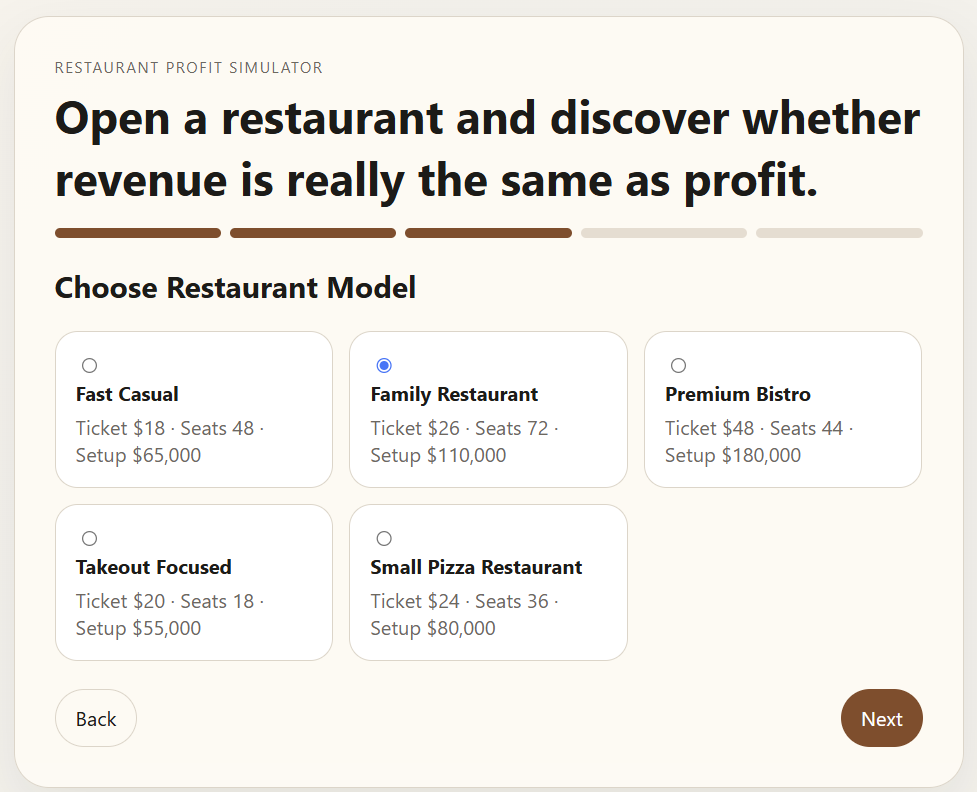
Understand the Family Restaurant operating model
In the simulator, Family Restaurant starts with 72 seats, a base ticket of $26, four chefs, seven servers, two cleaners, and one manager. Its modeled food-cost rate begins at 33% before ingredient-quality, city, event, and challenge modifiers. These values make it a larger dine-in operation than Fast Casual or Small Pizza Restaurant, but not a guarantee of higher profit.
The model works as a connected system. Foot traffic and reputation create potential demand. Price, satisfaction, promotions, advertising, and campaigns affect conversion. Seats, table turnover, service coverage, and chefs limit completed orders. Ingredient cost, payroll, rent, marketing, platform fees, and events then absorb revenue. Satisfaction and reputation carry today’s operating choices into future demand.
A strong run therefore balances four promises: enough demand to use the dining room, enough capacity to serve that demand, enough quality to protect trust, and enough contribution to cover fixed costs. Improving only one promise can weaken the others.
Build a clean one-month baseline
- Choose a moderate setting. Avoid combining the most expensive city and location until you understand how rent, wages, traffic, and spending power interact.
- Keep neutral operating choices. Use Balanced pricing, Standard Ingredients, the default average ticket and menu-quality settings, no promotion, Local Flyers, and the starting ad budget.
- Leave the starting staff in place. Turn Auto Hire off if you want staffing to remain a controlled variable.
- Run a complete month. Daily events and weekday patterns can distort a short observation, while the monthly report includes rent and summarizes the whole cycle.
- Record the evidence. Capture revenue, profit, cash, dine-in and delivery orders, lost customers, seat utilization, kitchen pressure, satisfaction, reputation, and each cost share.
This baseline is the comparison condition. A second run is useful only when the city, location, model, challenge, and other decisions remain the same. Random events can still differ, so repeat an important comparison before treating one result as a rule.
Use three calculations to interpret the report
| Measure | Calculation | What it helps answer |
|---|---|---|
| Profit margin | Monthly profit ÷ monthly revenue × 100 | Did the restaurant keep enough of each revenue dollar after all simulated costs? |
| Revenue per completed order | Monthly revenue ÷ (dine-in orders + delivery orders) | Did a pricing or promotion change improve the realized order value? |
| Incremental profit | Changed-run profit − baseline profit | Did the tested decision create more profit than the original setup? |
For example, if revenue rises from $90,000 to $99,000 while monthly profit falls from $7,000 to $5,000, the campaign created $9,000 of revenue but destroyed $2,000 of profit. Check food cost, payroll, marketing, and delivery fees to find the cause. Higher traffic is not success when each extra order contributes too little or overloads service.
Diagnose the dashboard before changing a control
| Pattern | Likely explanation | First controlled test |
|---|---|---|
| Low seat use and few lost customers | Demand is weak relative to current dine-in capacity. | Test one offer or price change, provided contribution is positive. |
| High lost customers and high kitchen pressure | Demand exceeds a service or kitchen constraint. | Add one relevant role or simplify the demand plan; do not promote harder. |
| Strong sales and weak monthly profit | Food, labor, rent, marketing, or delivery costs are absorbing revenue. | Use the profit bridge and cost shares to isolate the largest change. |
| Satisfaction falling with high utilization | The dining room, kitchen, service team, or ingredient decision is failing under load. | Stabilize capacity and quality before raising price. |
| Payroll share high with spare capacity | Staffing is ahead of proven demand. | Remove one unneeded addition in a matched run and watch service measures. |
| Delivery orders rise but profit weakens | Platform fees, promotions, and kitchen load may exceed added contribution. | Compare delivery share, fees, profit, and lost dine-in customers. |
Run four Family Restaurant experiments
1. Price after trust
When satisfaction and reputation are stable and capacity is not the main constraint, compare Balanced with Premium Pricing. Hold ingredients, staff, ticket slider, promotions, campaign, and ad budget fixed. A useful price increase may reduce order volume slightly while raising revenue per order and monthly profit. Reverse it when both demand and profit fall.
2. Staff the measured bottleneck
When lost customers and kitchen pressure remain high, add one role that matches the constraint. A chef supports kitchen throughput; servers support table service. Compare completed orders, lost customers, satisfaction, payroll share, and profit. Hiring is justified by incremental contribution and service improvement, not by the size of the restaurant alone.
3. Test the Family Weekend Deal
Use the model-specific deal only when the baseline shows weekend room, reliable service, and positive margin. Keep the campaign and advertising budget unchanged. The discount is useful if added completed orders create more profit than the reduced ticket sacrifices. It is harmful when it fills an already constrained operation or trains the run around low-margin volume.
4. Compare ingredient quality
Premium Ingredients raise modeled food cost and satisfaction potential; Cheap Ingredients lower cost and weaken satisfaction. Compare the full chain: food-cost share, satisfaction, reputation, completed demand, revenue, and profit. A quality investment needs future trust or pricing power to pay back. One month may reveal the immediate cost before the full reputation effect, so repeat the test.
Teach a 50-minute Family Restaurant investigation
- Frame the question — 5 minutes. Ask whether the first improvement should target demand, capacity, quality, or margin.
- Map the system — 7 minutes. Students connect traffic, conversion, capacity, completed orders, cost, profit, satisfaction, and reputation.
- Run the baseline — 10 minutes. Teams use the neutral setup and record the month-end evidence.
- Make one change — 10 minutes. Each team changes only price, one role, the weekend deal, or ingredient quality.
- Calculate and diagnose — 10 minutes. Students calculate profit margin, revenue per completed order, and incremental profit, then identify the limiting factor.
- Recommend and challenge — 8 minutes. Teams state a claim, cite two comparable measures, name one tradeoff and model limit, and propose the next test.
For a no-device route, provide two printed monthly summaries and ask teams to diagnose them from different perspectives: owner, customer, worker, or community. Assess the quality of the comparison and reasoning, not which group earns the highest simulated profit.
Keep the decision responsible and model-bounded
Restaurant Profit Simulator is an educational model, not a forecast or operating plan. It simplifies taxes, permits, food safety, accessibility, scheduling law, wages, insurance, leases, supplier contracts, allergens, nutrition claims, delivery contracts, waste, and local demand. A real restaurant must follow applicable health, employment, consumer-protection, privacy, advertising, accessibility, and licensing rules and use qualified professional advice where needed.
Do not treat lower labor cost, cheaper ingredients, or higher sales as automatically responsible. Ask whether the plan protects safe staffing, truthful offers, food quality, customer access, worker welfare, and reliable service. The simulator can reveal a tradeoff; it cannot decide the legal or ethical boundary.
Family Restaurant simulator FAQ
What is a good beginner setup for the Family Restaurant model?
Use a moderate-cost city and location, Balanced pricing, Standard Ingredients, the default ticket and menu-quality settings, no promotion, Local Flyers, and the starting staff. Run a complete month before changing one decision.
Should I hire more staff or attract more customers first?
Read demand and capacity together. Hire for a measured service or kitchen bottleneck when lost customers or pressure remain high. Attract demand only when there is spare capacity, reliable service, and positive contribution.
When should I use the Family Weekend Deal?
Test it after the baseline shows spare weekend capacity, stable satisfaction, and positive margin. Compare a full changed month with the baseline and keep the deal only if incremental profit improves without creating overload.
How can revenue rise while Family Restaurant profit falls?
Discounts, premium ingredients, added payroll, advertising, rent, delivery platform fees, or events can absorb the extra revenue. Use the profit bridge and monthly cost shares to identify which cost grew faster than contribution.
Can this guide be used for a classroom lesson?
Yes. Students can run a baseline and one matched change, calculate profit margin and revenue per completed order, explain one tradeoff, identify a model limitation, and recommend the next controlled test in about 50 minutes.