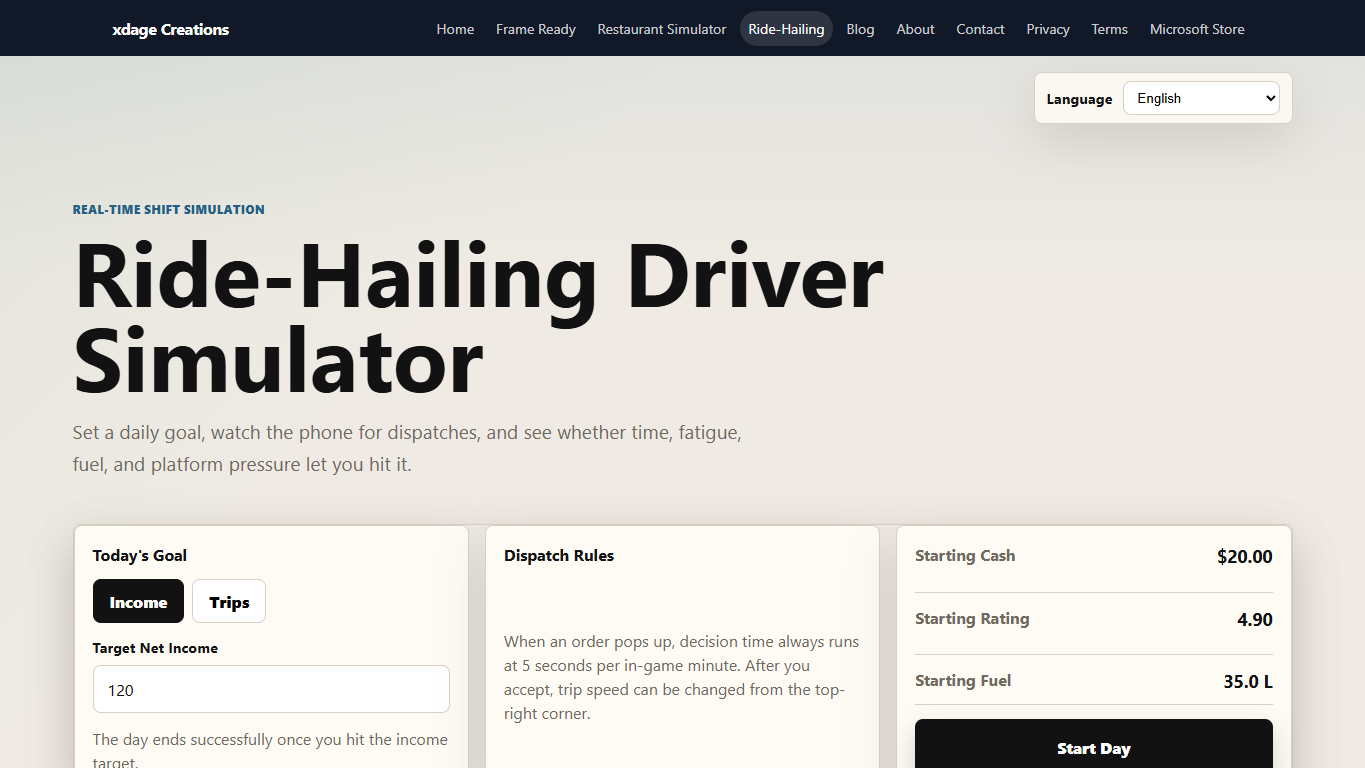
Step 1
Set a goal you can test
Choose an income or trip target before the shift. That turns each dispatch into a decision with a clear success measure rather than a click-for-score exercise.
Play the ride-hailing simulationBusiness simulation games
Practice pricing, staffing, capacity, marketing, service quality, and cash flow with focused browser-based micro-simulations. No account required.
xdage offers free, no-login business simulation games for restaurants, motels, dry cleaning shops, pet stores, grocery stores, coffee shops, lemonade stands, food trucks, car washes, fitness studios, hair salons, auto repair garages, landscaping companies, bakeries, bookstores, comic shops, childcare centers, ride-hailing, and indoor racket court facilities. Each simulator focuses on practical profit decisions rather than long account-based gameplay.
What you learn
See how rate changes affect bookings, conversion, revenue, and lost customers.
Balance payroll against service capacity, satisfaction, reviews, and reputation.
Use daily breakdowns and monthly reports to separate revenue from actual profit.
What a short simulation looks like
The ride-hailing micro-simulation makes the learning loop concrete: set a measurable goal, respond to dispatches, and compare income with the time, fuel, rating, acceptance, and fatigue consequences of each choice. It runs in the browser with no account.
Screenshots show a fictional educational model. Results are not forecasts, platform guidance, or financial advice.
Step 1
Choose an income or trip target before the shift. That turns each dispatch into a decision with a clear success measure rather than a click-for-score exercise.
Play the ride-hailing simulation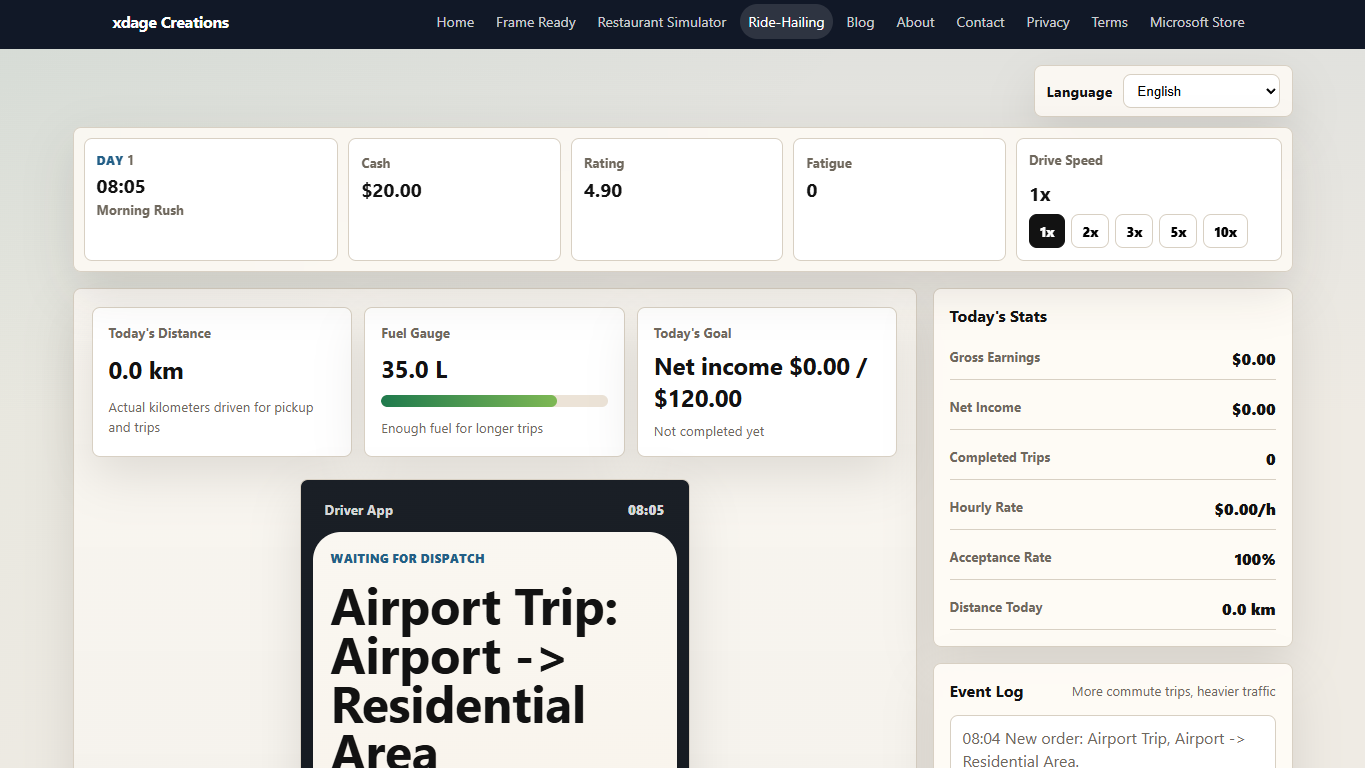
Step 2
Gross earnings alone do not explain the outcome. Compare net income and hourly rate with distance, fuel, rating, fatigue, and rejected work before defending a strategy.
Browse by business type
Restaurant, motel, coffee shop, lemonade stand, food truck, and bakery.
Grocery store, pet store, bookstore, dry cleaning, and hair salon.
Ride-hailing, car wash, auto repair, and landscaping.
Browse by decision
Each guide compares several simulations through one operating lens, then gives you a controlled experiment, result checks, classroom routes, and responsible-use boundaries.
Test assortment, stock levels, availability, freshness, shrink, replenishment, cash, and margin across six models.
Compare appointments, queues, route density, equipment, quality, trust, capacity, and completed work across seven models.
Connect guest demand with rooms, seats, production, staffing, experience, waste, and profit across six models.
Follow price through demand, completed sales, contribution, capacity, cash, and profit across eight models.
Calculate workload, practical capacity, utilization, service buffers, payroll, quality, and bottlenecks across eight models.
Test truthful offers and promotion while separating reach, potential demand, completed sales, retention, and profit across eight models.
Trace working capital, fixed commitments, contribution, lowest cash, runway, reserves, and investment timing across eight models.
Stress-test exposure, controls, continuity, recovery, response costs, shifted burdens, triggers, and stop rules across eight models.
Map process flow, find constraints, test improvements, and balance completion, wait, quality, waste, reliability, cash, and profit across eight models.
Frame positioning, connect choices, compare real alternatives, test tradeoffs, and write evidence-based recommendations across eight models.
Visual result examples
A simulation result is more than a score. Read demand, capacity, satisfaction, cost, and profit together, then ask which operating choice caused the pattern. These original gameplay examples link to a complete strategy explanation for each model.
Screenshots show simulated fictional businesses and educational estimates, not forecasts or operating advice for a real restaurant.
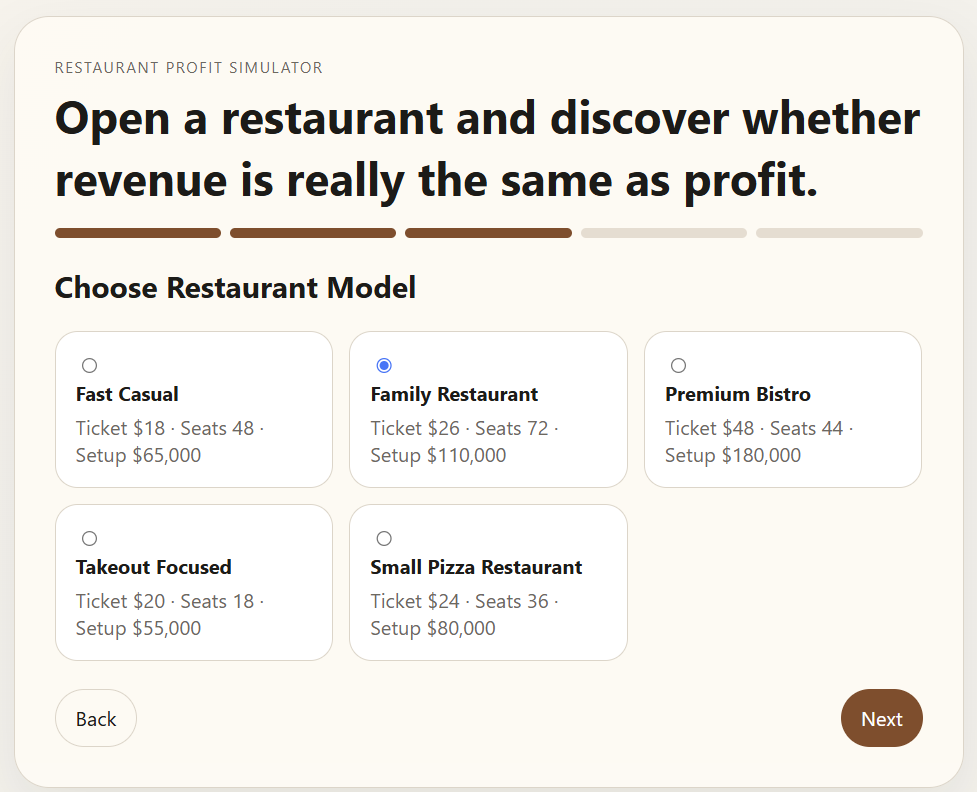
Stable seating demand, broad service needs, family promotions, and repeat visits.
Read the model guide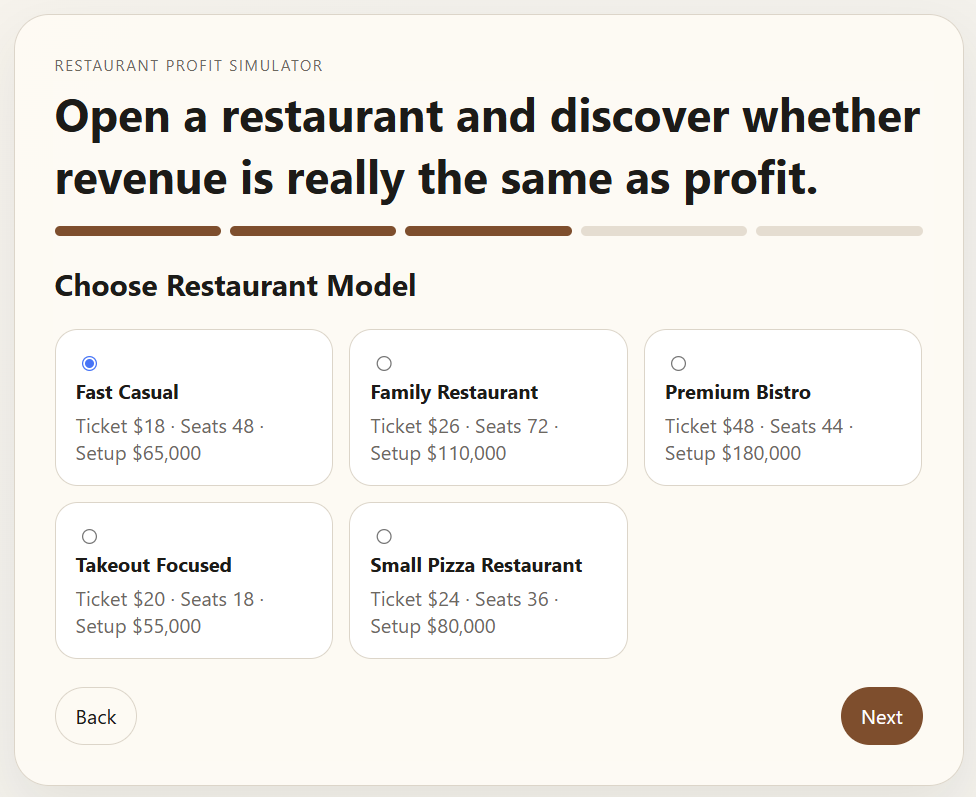
Higher throughput, balanced pricing, counter-service capacity, and promotion timing.
Read the model guide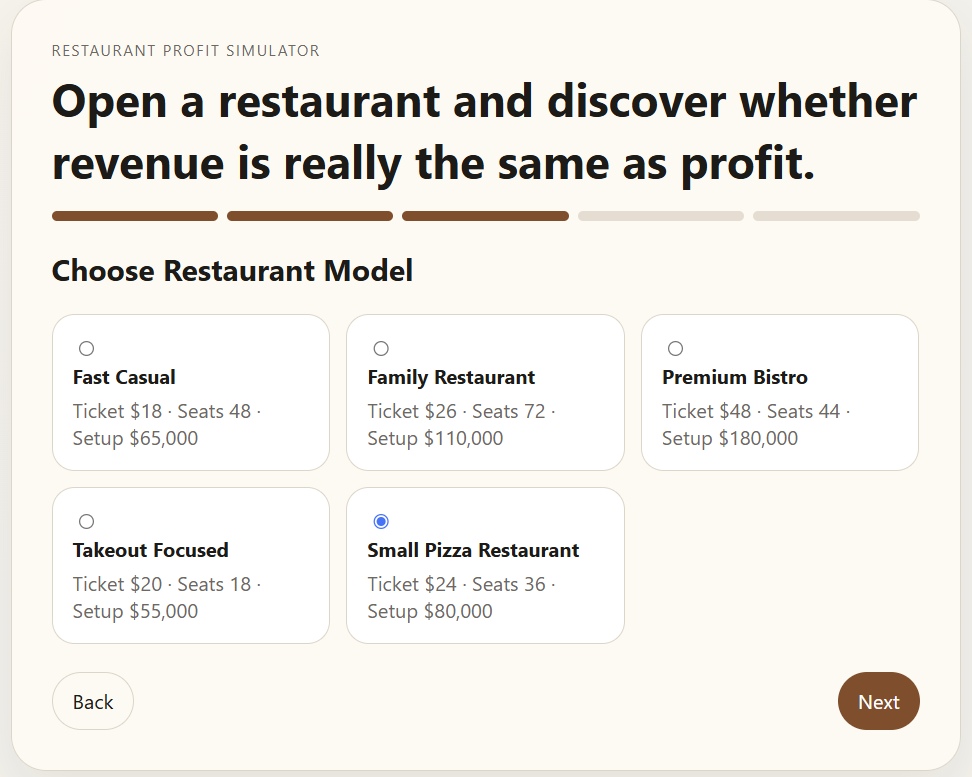
Compact menu economics, oven capacity, delivery demand, and ingredient discipline.
Read the model guide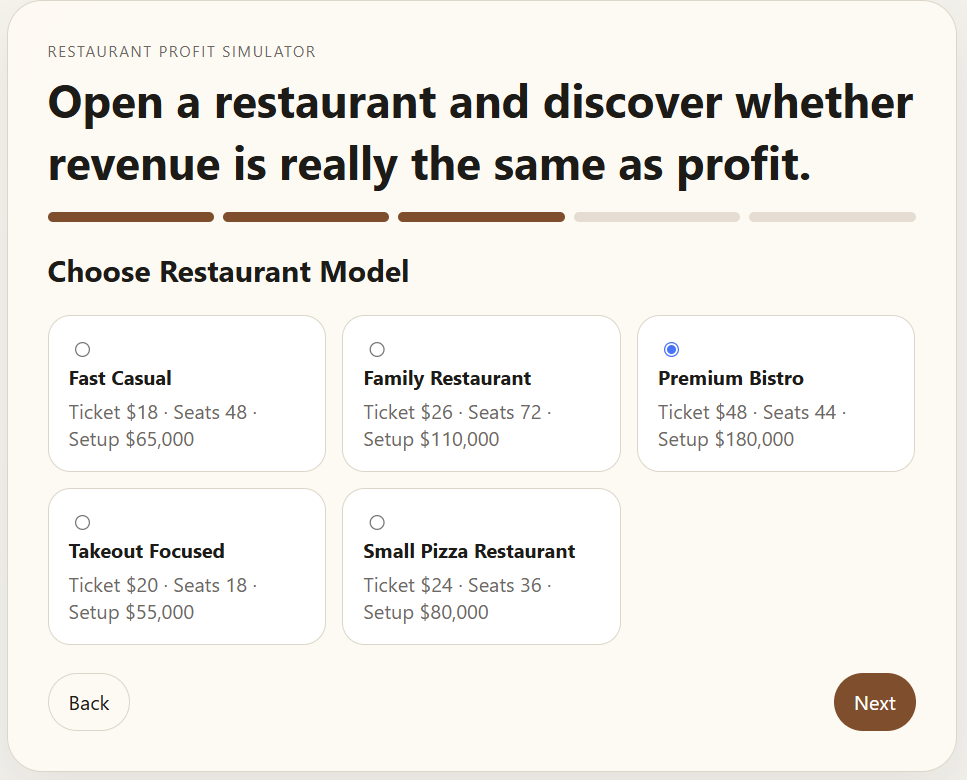
Pricing power, ingredient quality, skilled service, and slower table turnover.
Read the model guide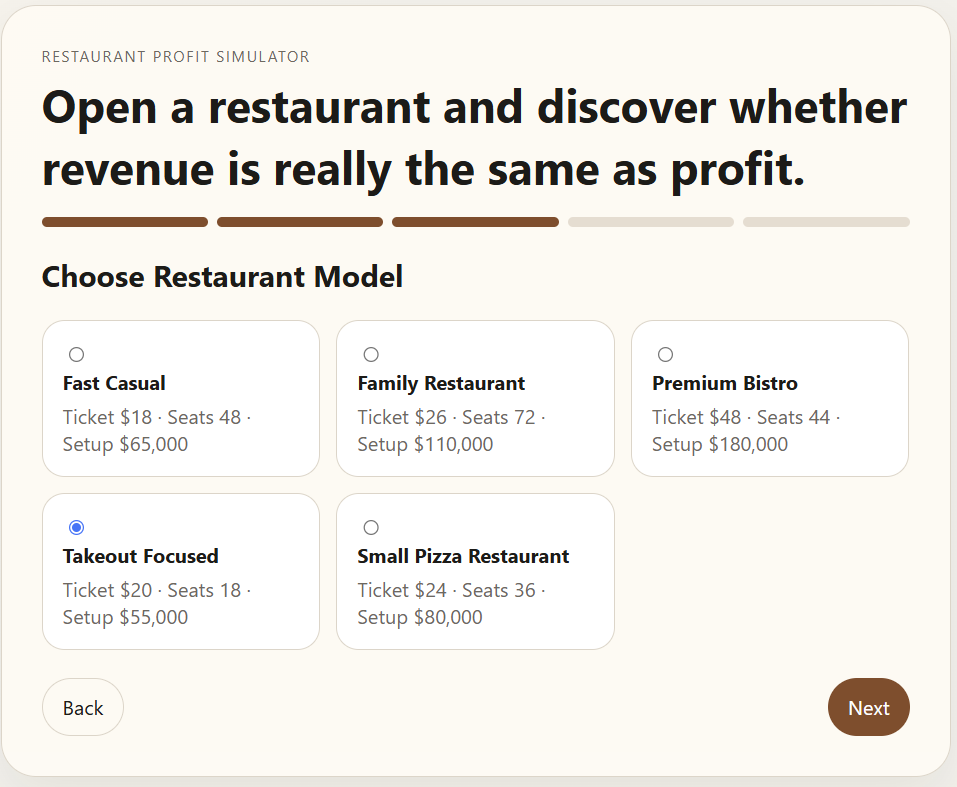
Delivery volume, platform fees, packaging cost, and kitchen throughput pressure.
Read the model guideClassroom & lab features
Every simulation in our catalog includes URL scenario codes and 1-click classroom launchers. Teachers can dispatch a single link so every student device launches on the exact same city, model, initial cash, and challenge baseline without manual configuration.
Launch preset scenarios directly from any printable worksheet with one click.
Export rich spreadsheets with formula injection defense and UTF-8 BOM encoding.
Complete seamless translation in English, Simplified Chinese, Traditional Chinese, and Korean.
Choose a simulator
Each game is designed as a short business lab with a specific operating model.
Run a restaurant through menu pricing, ingredient quality, staffing, delivery, marketing, customer traffic, and monthly profit pressure.
Best for learning: price strategy, labor cost, customer satisfaction, promotion tradeoffs, and cash flow.
Play restaurant simulatorManage nightly rates, occupancy, room condition, booking channels, staffing, maintenance, guest reviews, and RevPAR.
Best for learning: capacity, service quality, channel fees, reviews, and fixed-cost pressure.
Play motel simulatorOperate table tennis, badminton, squash, racquetball, and pickleball courts through bookings, memberships, programs, staffing, and equipment upkeep.
Best for learning: utilization, recurring revenue, maintenance backlog, and profit per capacity hour.
Play racket court simulatorWork a driving shift by accepting or rejecting trips while managing time, fuel, fatigue, platform fees, driver rating, and income goals.
Best for learning: unit economics, opportunity cost, fatigue risk, and goal-based decision making.
Play ride-hailing simulatorRun a dry cleaning shop through order pricing, turnaround promises, stain quality, staffing, machine uptime, delivery, reviews, and profit.
Best for learning: service capacity, backlog, rework, machine condition, customer satisfaction, and margin pressure.
Play dry cleaning simulatorRun a pet store through retail pricing, product mix, grooming capacity, animal care, habitat cleanliness, staffing, local events, reviews, and profit.
Best for learning: retail margin, service capacity, animal welfare, inventory quality, reputation, and cash flow.
Play pet store simulatorRun different grocery store formats through pricing, product mix, freshness, shelf availability, checkout staffing, suppliers, promotions, shrink, reviews, and profit.
Best for learning: grocery margins, fresh inventory, stockouts, shrink control, checkout capacity, and retail reputation.
Play grocery store simulatorRun a café through drink pricing, menu focus, barista staffing, queue time, drink quality, supplier choices, promotions, waste, reviews, and profit.
Best for learning: service capacity, queue management, quality investment, ingredient cost, waste, and café margin.
Play coffee shop simulatorRun a beginner-friendly booth through cup pricing, recipe quality, batch size, helpers, signs, weather, demand, serving capacity, waste, and profit.
Best for learning: contribution per cup, break-even sales, fixed and variable costs, controlled tests, capacity, and inventory waste.
Play lemonade stand simulatorRun a food truck through event locations, menu pricing, prep capacity, cook staffing, queue time, food quality, supplier choices, promotions, waste, reviews, and profit.
Best for learning: mobile food service capacity, location demand, prep inventory, service speed, ingredient cost, and daily cash.
Play food truck simulatorRun a car wash through package pricing, bay utilization, chemical cost, attendants, detailers, memberships, reviews, waste, equipment uptime, and profit.
Best for learning: service bay capacity, wash package margin, labor coverage, chemical inventory, review quality, and recurring membership demand.
Play car wash simulatorRun a fitness studio through memberships, classes, trainer staffing, churn, equipment condition, marketing, reviews, and recurring profit.
Best for learning: recurring revenue, class capacity, coach coverage, member retention, equipment upkeep, and service reputation.
Play fitness studio simulatorRun a salon or barbershop through appointment pricing, stylist utilization, walk-ins, product sales, wait time, retention, tips, reviews, and profit.
Best for learning: service appointment pricing, chair utilization, labor coverage, retail add-ons, wait time, rebooking, and tips.
Play hair salon simulatorRun an auto repair garage through diagnostic time, parts margin, mechanic staffing, bay capacity, comeback repairs, customer trust, reviews, and profit.
Best for learning: repair bay utilization, technician coverage, parts cost, diagnostic backlog, quality control, comeback risk, and trust.
Play auto repair simulatorRun a landscaping company through route density, crew staffing, fuel, seasonal demand, equipment maintenance, contracts, reviews, and margin.
Best for learning: service route density, truck capacity, crew coverage, fuel cost, seasonal demand, equipment uptime, contract mix, and job margin.
Play landscaping simulatorRun a bakery through production planning, ingredient cost, freshness, waste, morning rush capacity, wholesale orders, reviews, and profit.
Best for learning: oven capacity, batch planning, baker coverage, ingredient cost, freshness, wholesale demand, waste, and margin.
Play bakery simulatorRun a bookstore or comic shop through inventory curation, events, staff recommendations, slow-moving stock, online competition, reviews, and margin.
Best for learning: buying mix, staff picks, event demand, stale inventory, online marketplace pressure, and retail margin.
Play bookstore simulatorRun a childcare center through enrollment, staffing ratios, tuition, safety quality, licensing pressure, parent satisfaction, reviews, and cash flow.
Best for learning: service capacity, regulated staffing, tuition strategy, quality investment, compliance readiness, parent trust, and cash flow.
Play childcare simulatorWhy micro-simulations
Enterprise business simulation platforms can be deep, account-based, and classroom-driven. xdage business simulations are intentionally smaller: open a page, make decisions, read the results, and try a different strategy. That makes them useful for quick practice, article examples, self-study, and short classroom discussions.
The goal is not to reproduce every business variable. The goal is to make tradeoffs visible: a higher price can reduce demand, more staff can improve service but hurt profit, and strong revenue can still hide weak margins.
For classrooms
Use the simulations as short activities for pricing, labor, occupancy, utilization, trip acceptance, service capacity, retail inventory, animal care, freshness, shrink, churn, stylist utilization, mechanic staffing, route density, crew staffing, production planning, ingredient cost, freshness, wholesale orders, inventory curation, staff recommendations, slow-moving stock, enrollment, staffing ratios, licensing readiness, parent satisfaction, trust, retention, and profit reflection. The classroom page includes 15-minute and 30-minute prompts plus printable worksheets for each simulator.
Ask students whether a faster turnaround promise improved profit after backlog, rework, staffing, and machine capacity were included.
Ask students to identify the tradeoff between retail growth, grooming capacity, animal welfare, cleanliness, and customer trust.
Ask students whether promotions or low prices still helped profit after freshness, stockouts, shrink, and checkout wait were counted.
Ask students whether higher traffic still helped profit after barista labor, queue time, drink quality, ingredient cost, and waste were counted.
Ask students whether a better location still improved profit after permit cost, prep inventory, cook staffing, queue time, food quality, and waste were counted.
Ask students whether more memberships or premium packages still improved profit after bay capacity, chemical cost, queue time, labor, and wash quality were counted.
Ask students whether more memberships still improved profit after class capacity, trainer payroll, churn risk, equipment condition, and reviews were counted.
Ask students whether more walk-ins still improved profit after stylist utilization, wait time, product cost, retention, reviews, and tips were counted.
Ask students whether more repair requests still improved profit after diagnostic time, parts margin, mechanic payroll, comeback repairs, and trust were counted.
Ask students whether denser routes still improved profit after crew staffing, fuel, equipment maintenance, seasonal demand, contract mix, and service quality were counted.
Ask students whether higher morning or wholesale demand still improved profit after baker labor, ingredient cost, freshness pressure, oven capacity, and waste were counted.
Ask students whether events or broader inventory still improved profit after staff labor, buying cost, stale inventory, online competition, and margin pressure were counted.
Ask students whether higher enrollment still improved profit after teacher payroll, staffing ratios, safety quality, licensing pressure, parent satisfaction, and cash flow were counted.
Explore by search intent
These focused pages answer common questions about free business games, classroom use, small-business practice, restaurant operations, and motel operations.
FAQ
A business simulation game lets you make operating decisions such as pricing, staffing, marketing, capacity, and service quality, then see how those decisions affect revenue, costs, profit, and customer satisfaction.
Yes. The xdage business simulations are free to play in a web browser and do not require an account.
Start with Restaurant Profit Simulator for the broadest small-business example or Lemonade Stand Simulator for a beginner-friendly introduction to contribution margin and break-even sales. Choose Coffee Shop for queues and staffing, Food Truck for location and prep capacity, Motel for occupancy and reviews, Ride-Hailing for shift decisions, or use the category guide above to match a simulator to the skill you want to practice.
Yes. They are short micro-simulations designed to help players practice practical business tradeoffs such as cash flow, pricing, staffing, utilization, demand, and profit margin.